Fill out one form instead of calling around for an air conditioner tune-up.
On a hot Georgia day your AC should run long stretches, sometimes close to nonstop when it's in the mid 90s with the humidity sitting heavy. That's normal. What's not normal is when it never shuts off at all, or when it cycles on and off every few minutes. Either one is a sign something is working harder than it should.
A system that short cycles is usually losing the fight against the heat before it even gets going. One that runs all day without ever satisfying the thermostat might be low on refrigerant, blocked up somewhere in the ductwork, or just worn down enough that it can't keep pace with a Georgia summer anymore. With most homes here running on electric heat and cooling both, a struggling AC shows up fast on the power bill too.
Figuring out which of these is happening to your system isn't something you can tell just by listening to it run. It takes someone who works on these systems all season, in this heat, and knows what tends to fail first in a Georgia summer versus what's actually fine.
That's the part that usually takes more time than the fix itself. Most people start by searching around, calling a few places, waiting on callbacks, explaining the same symptoms over again to each one, then trying to compare quotes that aren't even for the same scope of work. All of that before anyone's even looked at your unit.
Here, that step is skipped. You're connected with one licensed contractor local to your area, someone who already knows the patterns particular to homes and systems around here, so you're not fielding calls from five different companies trying to win the job. Just the one, ready to look at what your system is actually doing on a day like today.
Is it normal for my AC to run almost all day in Georgia?
You've noticed your AC barely shuts off some afternoons, and you're starting to wonder if that's a sign something's wrong, or if it's just what Georgia summers do to a system. You're not looking to panic over every long run, but you want to know where the line is between normal and a problem worth calling someone about.
Yes, long runs are normal here once it's hot enough
A properly sized system is built to keep running when the heat and humidity both push hard, and Georgia summers do that for weeks at a stretch. Your AC isn't just cooling the air, it's also pulling moisture out of it, and that takes longer when the outdoor air is heavy with humidity. On a 95 degree day with high humidity, a unit running most of the afternoon is doing what it's supposed to do. The time to pay attention is when it stops behaving like that: running every single minute around the clock with no break at all, or short cycling where it shuts off and restarts every few minutes. Those patterns point to something specific going wrong, not just a hot day.
Why long run times make sense
A hot day doesn't just raise the temperature outside, it raises the humidity your AC has to pull out of the air along with it. Georgia summers push both at once, so the system spends more time moving heat out of the house than it would somewhere dry. A unit sized correctly for your home will run long stretches on a 95 degree day and still keep up. That's the system doing its job under a heavier load, not a sign it's struggling.
What a tune-up actually checks
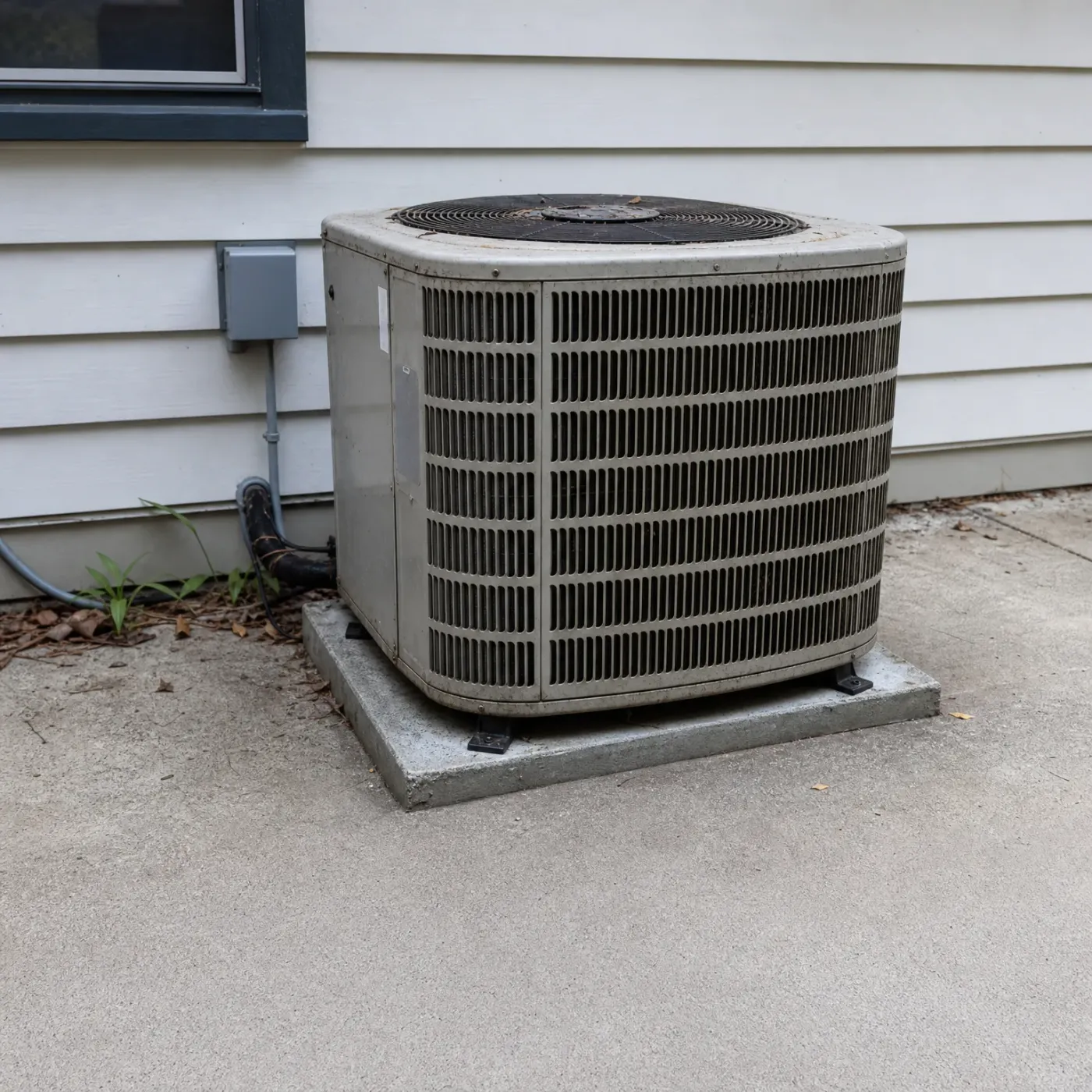
Maintenance on a system like yours means checking refrigerant charge, cleaning the outdoor coil, and testing the capacitor and contactor, the parts most likely to wear out from long summer run times. A coil caked with dirt can't shed heat as well, so the system runs longer to do the same job. Catching a weak capacitor before it fails means catching it before it leaves you without cooling on the day you need it most.
Before you get your air conditioner maintenanceAfter you get your air conditioner maintenance
Skip the search
A licensed local pro takes the request for your air conditioner tune-up.
Skip calling around to set up an air conditioner tune-up.
The house holds right around your set temperature, maybe a degree off on the worst afternoons.
Air coming out of the vents feels noticeably cold when you hold your hand near one.
The outdoor unit runs steady without short bursts, then shuts off once the house catches up in the evening.
Your power bill moves with the weather, higher in July and August than it is in April or October.
The system quiets down overnight once the sun's been down a few hours and the heat load drops.
Long run time, something's wrong
The house still reads a few degrees warmer than the thermostat setting no matter how long the system runs.
Air from the vents feels only cool, not cold, even after the unit has been running for an hour straight.
The outdoor unit never shuts off at all, even at night when it's cooler outside and the house isn't fighting as much heat.
You hear the system cycling on and off every few minutes instead of running one long stretch.
Ice shows up on the refrigerant line or the indoor coil, which has no business forming in a system that's working right.
Your bill jumps well beyond what the last few hot summers cost you to run the same system.
A long run time on a 95 degree day with the unit cycling steady and cold air still coming through the vents.
A long run time that never ends because the unit outside is older and struggling to keep up with a Georgia afternoon.
If your AC runs most of the afternoon and the house still holds near your set temperature, that long run time is doing its job, and it will keep costing you the same electric bill all summer as long as the system can keep up.
The afternoon it can't keep up, you'll feel it first in the back bedroom or wherever your ducts run longest, the house creeping up a degree at a time while the outdoor unit never shuts off.
Power costs 14.74 cents per kilowatt-hour statewide
At 14.74 cents per kilowatt-hour, those long afternoon run times show up on your bill whether the system is working fine or struggling. A unit that's maintained moves the same heat and humidity out of your house for less power than one running dirty coils or a low charge.
EIA-861 2025 statewide residential average
1
Your thermostat senses the room above your set point.
2
The outdoor compressor kicks on and starts pulling refrigerant through the system.
3
Refrigerant inside the indoor coil pulls heat and moisture out of the air.
4
The blower pushes that cooled, drier air through your ducts.
A long run time on a hot Georgia afternoon isn't the problem. What matters is whether your AC is keeping the house cool while it runs, or just running without catching up. If the air out of the vents is cold and the house holds near your set temperature, the system is doing what it's supposed to do. If it's not, something inside it is working harder than it should, and that's usually something a maintenance visit catches before it leaves you without cooling on the next 95 degree day. A contractor local to your part of Georgia who services these systems all summer has seen what a unit looks like after weeks of long run times in this humidity, and knows what tends to wear first. You'll be matched with one contractor, not several, so you're not stuck fielding calls and comparing quotes while your house sits at 80 degrees. You'll know where your system stands, and whether that long run time is normal for your house or a sign of something that needs attention now.
Air Conditioner Maintenance
Explain it one time
Step 1 of 3: Equipment
A local pro who services air conditioners gets in touch about the tune-up.
Describe your air conditioner job, and a local pro who handles it gets in touch.
Send the form and the air conditioner tune-up stops being something to remember.
One request and finding someone for the tune-up is handled.
Explain the job once and skip repeating it on every call.
Skip searching for an air conditioner pro and answer a few questions instead.
The pro who reaches out is licensed in Georgia.
Only one pro gets your request, so you hear from one company.